History of Derby Market Hall
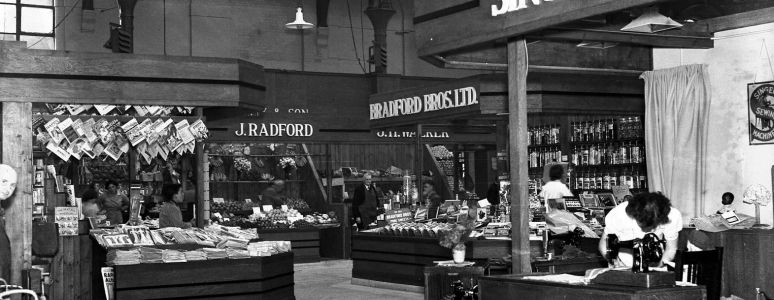
The History of Derby Market Hall
All images are generously provided courtesy of Derby Libraries and Derby Local Studies & Family History Library. Interested in finding out more about the history of markets and shopping in Derby? Find out more about the collection and how you can get involved on their website.
Origins
A Long History of Market Trading
Market trading has been at the heart of Derby life for centuries. In 1229, King Henry III granted Derby its first Charter Market, formally recognising its importance as a centre for trade. By 1610, a permanent, enclosed Market Place was recorded on Speed’s Map of Derby.
Birth of the Market Hall
By the mid-1800s, Derby’s market facilities were overcrowded and unsanitary. In response, the Borough Council, led by Mayor Frederick Longdon, commissioned a new covered Market Hall - a bold Victorian statement of civic pride and modernisation. The design was begun by Borough Surveyor Robert Thorburn, with the foundation stone laid in February 1864. It was completed in 1866 by his successor Edwin Thompson, at a cost of £29,000 (about £2.4 million today).
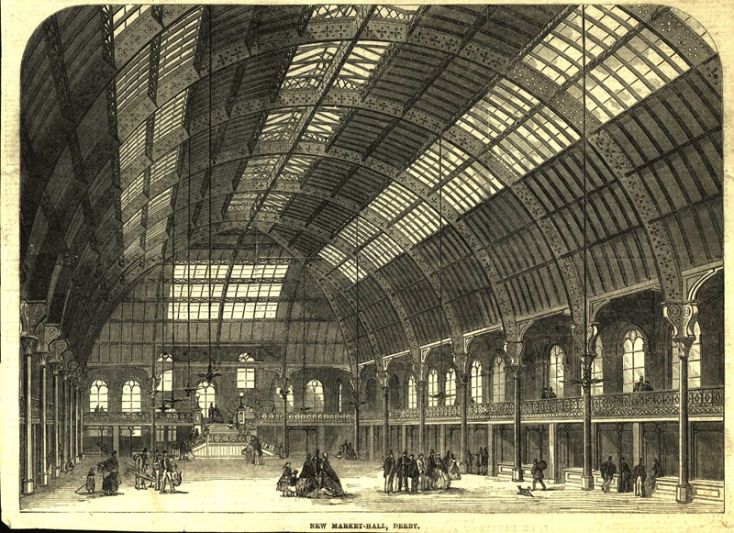
Victorian Ingenuity
The stand-out feature of the Market Hall is its impressive barrel-vaulted roof, designed by renowned engineer Rowland Mason Ordish, known for his work on the Royal Albert Hall & St Pancras Railway Station. The original design included a large louvred lantern, weather vane and corner turrets. Internally, rainwater was cleverly channelled through hollow cast iron columns, a testament to Victorian ingenuity.
A Grand Opening
The new Derby Market Hall building had its grand opening on 29th May 1866, which was marked by a 600-strong choral performance of Handel’s Messiah, reflecting the significance of this new civic landmark.
Evolution
Changing with the Times
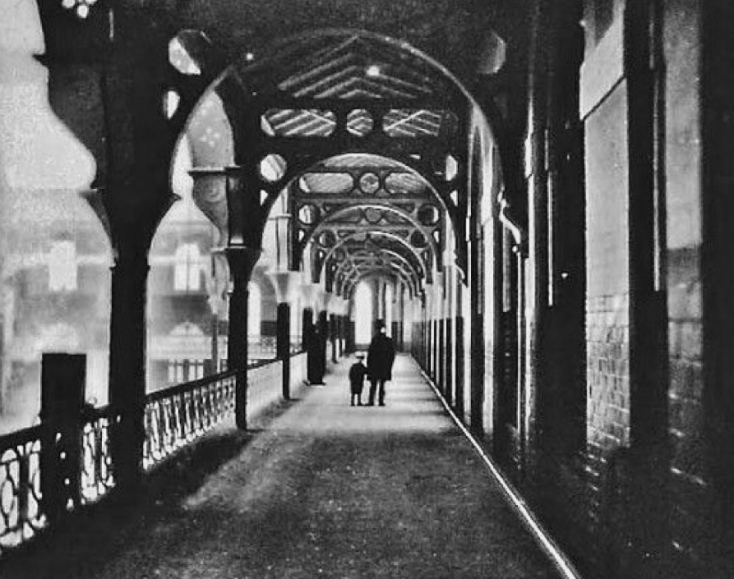
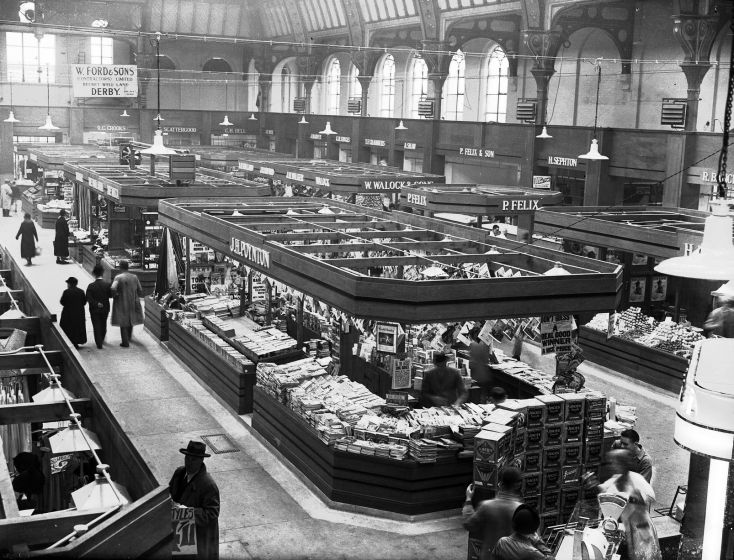
Throughout the 20th century, Derby Market Hall has adapted to meet changing needs, with the addition of heating, electric lighting and updated stall designs. A significant refurbishment in 1938 saw improvements to the layout with the loss of the twin northern entrances and the feature staircase. The interior was given a contemporary, sleek appearance with cast terrazzo flooring, modern central stalls and the decorative balustrade was concealed and boxed-in.
Weathering the Elements
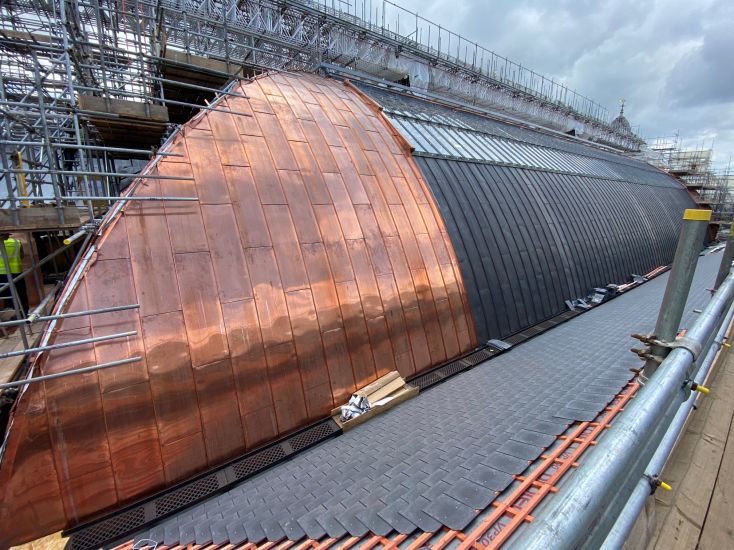
The roof of the building has also evolved. Extensive roof repairs between 1947-1949 saw the replacement of rotten timbers, with new glazing and aluminium glazing bars. In 1965, the original slate and zinc roof coverings were replaced with copper, with its distinctive green appearance. The copper roof covering was recently replaced, which will, in time, also turn green.
A New Wave Renovation
In 1989, the Market Hall underwent further modernisation. The original north-south balconies were extended,
together with a new panoramic lift and stair feature, offering new vantage points across the impressive interior.
A new northern lift and stair tower was constructed, and an extension was built to the east of the building, to
house essential trader storage areas, public toilets, and office accommodation.
Digging through the Layers
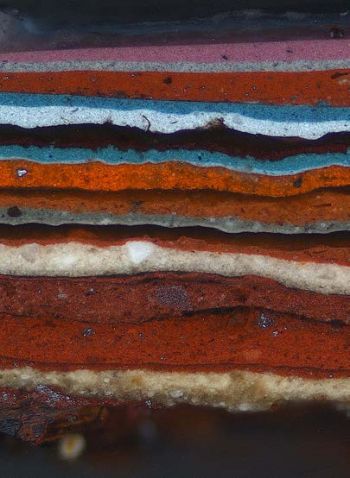
Over the decades the Market Hall has been redecorated with new layers of paint that represent the changing tastes through the eras. Each layer reflects the attitudes of the time, marking a point of transition for the building, whilst also taking the building further from its original design. By carefully analysing the paint layers through a series of samples, shown opposite, the building has been reverted back to something closer to its original colour scheme, with a fresh coat of paint that is reflective of its past.
Fishy Business
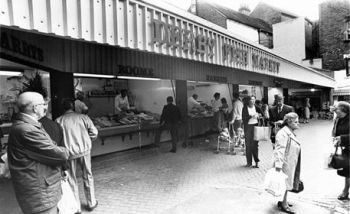
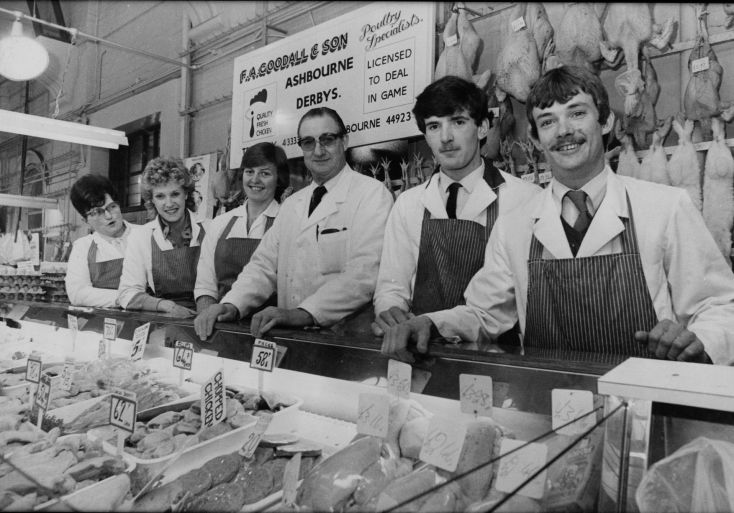
The Fish Market was first housed in the separate hall at the southeast of the Market Hall. In 1926 a rudimentary extension was built on what is now Osnabrück Square, which served as an expanded fish, game and poultry market for over five decades. This extension was demolished in 1981, with the creation of the new Fish Market in Lock-Up Yard.
Discovery
Eyes on the Square
The demolition of the Fish Market extension revealed a largely blank elevation to the south of the Market Hall, except for a few small windows, and the doorway created through to the Poultry Market. The solution at the time was to reinstate the brickwork and stone plinth to create a solid elevation. As part of the most recent renovations, the building now makes the most of its southern aspect with new windows fronting onto Osnabrück Square.
Keeping Time
One element introduced in the 1980s, that has been preserved in the recent renovations, is the clock by Smith of Derby. Originally mounted above the panoramic lift, this has now been rehoused and re-mounted on the wall along the first floor balcony.
The Lost Elevation
The market store extension added in the 1980s has largely concealed the original east elevation of the Market Hall. Glimpses of the original grand expanse of brick and stone are still visible. Take a moment in the lobby of the toilets, or visit the stall off the balcony, to see the stone piers of the old east door.
Opening up the Poultry
Originally the Poultry Market was a double-height space. The upper floor was installed in the space in the 80s, concealing the grandeur of this secondary hall. Now a sense of the space has been restored by cutting back the inserted floor and adding in new windows.
Time Capsule
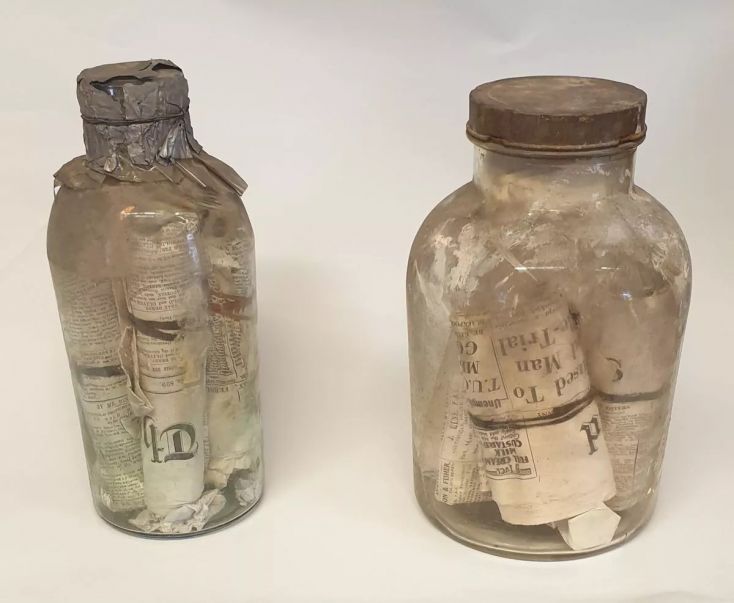
During the recent refurbishment works, a brick wall blocking-up one of the historic northern entrances was re-opened to uncover two time capsules in large glass jars. These date from the laying of the original foundation stone in 1864, and the relocation of the foundation stone in 1938. The foundation stone has since been repositioned back to its original central location, and both time capsules, together with a new one from 2024, have been concealed within the walls of the building.
Restoring Lost Features
The tide of history has worn away at the Market Hall, which has led to the loss of a number of original features. Many of these losses afflicted the north elevation, facing the rear of the Guildhall. As part of the project, these lost features have been restored, including a small doorway into the stair tower and the paired entrance doors to the main hall, the original fanlights for which were rediscovered, having been bricked-up since the 1930s.
Copper Topped Market
Work to replace the vast copper roof revealed a layer of 1960s insulation - horsehair! Beneath this, spanning between the magnificent wrought iron beams, is a sea of timber boarding. More reminiscent of the hull of a ship than the roof of a building, the similarity is not surprising. The same techniques were used to construct copper-bottomed boats, such as the Cutty Sark, which was completed just 3 years after the Market Hall opened.
Lock-Up Yard
When the Market Hall was constructed, a building for detaining suspected criminals was established on the site of the current Fish Market. Prisoners were led through an underground tunnel, that linked through the Market Hall to the Courts within the Guildhall.