Audio Guide
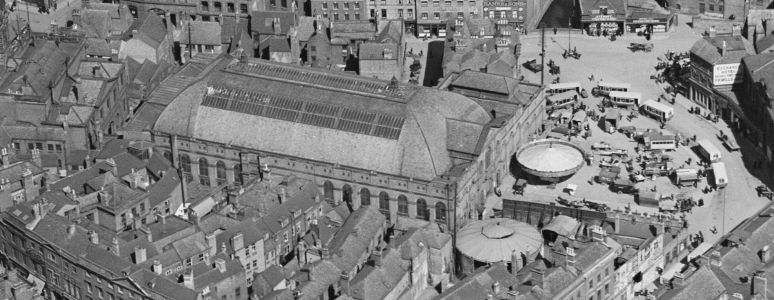
160 Years of Derby Market Hall
On 29 May 1866, the Derby Market Hall opened its doors to the public for the very first time. It was hailed as a triumph of Victorian engineering and a bustling hub for local traders.
Now, 160 years later, we are celebrating this incredible milestone. To honour the voices, the history, and the architecture that have shaped Derby for generations, we invite you to experience the Market Hall like never before with our exclusive anniversary audio guide: 160 Years of Derby Market Hall.
Audio tour created in partnership with Derby Uncovered CIC, Absolute Vocals and Andrew Edwards.
Listen to the audio tour
Full transcript
Come a bit closer. Don't be shy. You're standing in a place that has seen more life than most ever will. Generations have passed through here. Voices, laughter, arguments, bargains, and secrets too. This is Derby Market Hall. And if these walls could talk, well, you wouldn't get a word in. But fortunately for you, I've been listening. So let's take a walk back.
It's 1864. Derby is changing rapidly. Smoke fills the sky. Railways stretch across the country like veins. Industry is thriving and people are arriving in search of work. Back then, shopping was very different. No plastic packaging, no electronic tills. Everything was weighed by hand, wrapped in paper and you knew the person serving you. Markets weren't just a place to buy things. They were places to talk, to meet, to belong. And Derby wanted something better.
On 16 February 1864, Mayor Thomas Roe steps forward. A significant day. The foundation stone is about to be laid. That stone wasn't just about bricks and mortar. It was pride, ambition, a statement. Derby was saying: “we're building something that will last”.
By July, the walls are up, but there's a problem. The roof design isn't quite right. So, in steps Roland Mason Ordish, an engineer with vision. He designs the great iron roof above you.
And when it's finished, 29 May 1866: opening day. Imagine it. Light pouring through high windows, voices echoing across iron and stone, stalls neatly arranged. For the first time, Derby's market had a proper home. Shelter from the rain, order from chaos, a place that says this matters – and it did. Because this wasn't just a building, it was where life happened.
Now, step forward a few years. The 1870s: Victorian Britain is becoming more structured, focused on cleanliness, rules and public health. Markets like this are at the centre of it all. Food is inspected, space is organised, standards improved. But for shoppers, it builds trust. But not everything runs smoothly. There's an unusual problem.
Prisoners from the nearby police lock up are being marched through the market hall on their way to court. Imagine that you're buying vegetables and a man in chains walks past you – not ideal! So, a solution is found. A tunnel is built beneath the market hall, hidden out of sight, and it's still there today.
Places like this often have more beneath the surface than you realise. Time has taken its toll. The interior needs repainting. Maintaining appearances matters, but that same year brings tragedy. Police constable Joseph Moss is shot inside the lock-up and dies the following day. Even in places built for community, life can be harsh.
By the 1880s, change accelerates. Railways bring goods from across the country. Foods, once rare, like oranges, become more common. Good for customers, perhaps, but harder for local producers. Trade inside the market hall begins to decline. Concerns grow. Other markets are drawing people away. Some visitors can't even find this place. There's no clear signage. By 1889, it's serious enough to trigger a government inquiry. Because this isn't just about commerce. It's about survival. And from the very beginning, this market hall has had to adapt.
Now step forward again. The 1890s: electricity begins to appear. At first, it coexists with gas lighting. Old and new, side by side. Some embrace it, others distrust it. Gas lighting is removed. Electricity takes over. But the reaction mixed. It's too dim. Traders complain. Customers struggle to see the goods. By 1897, gaslighting returns. Change doesn't always happen smoothly.
The 1900s, by now, the market hall is a part of daily life. Regular hours, fixed stalls, familiar faces. But even in familiar places, things can go wrong. Two young boys light 16 separate fires inside the market hall. It could have been disastrous. But every fire is extinguished in time. A narrow escape.
The 1910s: war changes everything. During the First World War, food becomes scarce. Rationing begins. Markets like this one become essential, not optional. A woman named Alice Wheeldon walks through the tunnel beneath your feet. She is accused of plotting against Prime Minister David Lloyd George. She is later convicted, though many would question that judgement. Above ground, life continues.
The 1920s: radios bring the wider world into people's homes. But here, things remain familiar. A dedicated fish and poultry section opens. Lively, noisy and unforgettable.
The 1930s: economic hardship spreads across the country. Markets become even more important. Places where every penny counts. The Market Hall is decorated for the coronation of King George VI. Soon after, it closes for a major refurbishment. It reopens, renewed and ready, just in time.
The 1940s: war returns. Food is rationed again. The tunnels beneath the market hall become air raid shelters. Families gather below ground, waiting, listening. Even coffins are stored there, just in case. And yet, life continues.
The 1950s: recovery begins slowly. There are plans to relocate the market, but they never happen. Another fire breaks out. But once again, disaster is avoided.
The 1960s: shopping begins to change. Large chain stores gain power. Prices drop. Convenience increases. The shift is gradual but significant. The Market Hall celebrates its centenary. A hundred years of history.
The 1970s: economic uncertainty returns.
The 1990s: the Internet arrives. Shopping begins to move online. But inside the Market Hall, life continues much as it always has. A long serving trader, Harry Poynton, passes away after 67 years of service. A reminder that markets are built on people.
The 2000s: mobile phones and digital life accelerate change. A major shopping centre development impacts footfall. The challenge grows.
The 2010s: markets across the country begin to rethink their purpose. A decision is made. The Market Hall will close for more major redevelopment. And just like that, it falls silent.
Seven years pass. During that time, the world changes again. “The United Kingdom has today entered an unprecedented nationwide lockdown as the rapid spread of COVID 19 forces the government to take extraordinary action”. A global pandemic brings everything to a halt. But the Market Hall endures as it always has.
Two time capsules are discovered during restoration work. Messages from the past reaching forward. And then, the 24th of May 2025, the doors reopen and life returns. But something has changed. This is no longer just a market. It's something more.
There are still stalls, still traders, still connection. But now there is food from around the world. Places to sit, to stay, to gather. Events, experiences, community. More than a market. Because that's what it's always been. Not just a place to buy things, but a place to belong. Generations have stood where you are now. And now you are part of that story too.
This building isn't just brick and iron. It is memory. It is identity. It is Derby. Welcome to Derby Market Hall.
Derby Market Hall is proud to celebrate its 160th anniversary in 2026.
We'd like to thank Derby Uncovered CIC, Absolute Vocals and Andrew Edwards for their support with this audio.